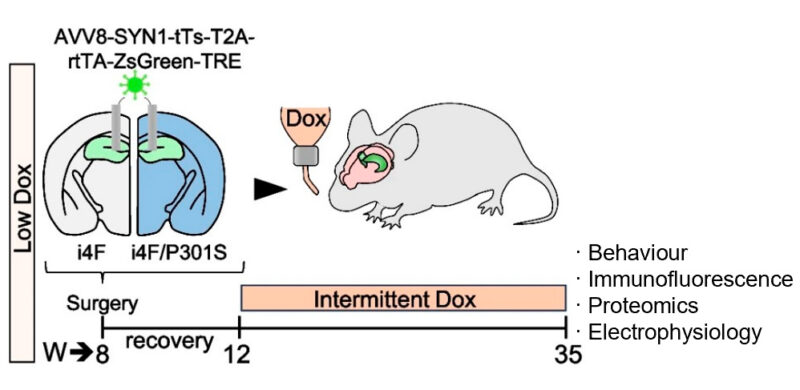
En este artículo, hemos utilizado los factores de Yamanaka para rejuvenecer las neuronas de un modelo animal de demencia y hemos observado que la reprogramación parcial de estas células mejora algunos de los déficits de memoria y alteraciones sinápticas asociados a esta enfermedad. Este enfoque supone una vía prometedora para revertir algunas de las alteraciones asociadas al envejecimiento, el principal factor de riesgo para el Alzheimer y otras enfermedades neurodegenerativas.
Resumen
Alzheimer’s disease (AD) is the most prevalent neurodegenerative disorder and represents a major societal burden. Aging is the strongest risk factor for AD, and partial cellular reprogramming using Yamanaka factors (YFs) has recently emerged as a strategy to counteract age-associated dysfunction. However, the mechanisms by which partial reprogramming ameliorates AD-related phenotypes remain poorly defined. Here, we investigated whether targeted and intermittent expression of YFs in hippocampal neurons restores cognitive function and neural network integrity in the P301S mouse model of tauopathy. We first show that controlled YFs expression in hippocampal neurons increases excitatory synaptic transmission and enhances neural synchrony in GCaMP6-expressing neuronal networks. We then induced intermittent, neuron-specific YFs expression for six months in adult control and P301S mice. This intervention led to a sex-dependent improvement in cognitive and emotional behaviors in P301S mice, accompanied by a reduction in Tau pathology and partial restoration of epigenetic aging markers. At the molecular level, reprogramming restored the composition and signaling of N-methyl-D-aspartate receptor (NMDAR) macro-complexes, including key subunits and AD-associated risk factors such as proline-rich tyrosine kinase 2 (PYK2/PTK2B). Importantly, impaired hippocampal neural synchrony observed in P301S mice was also rescued. Together, these findings demonstrate that targeted, partial in vivo neuronal reprogramming reverses behavioral and network-level deficits in a mouse model of AD and identify NMDAR-associated signaling as a potential mechanistic mediator of this effect.

septiembre 2026
Sobre el grupo investigador
Este trabajo de investigación es fruto de la colaboración entre los grupos del Dr. Albert Giralt y el Dr. Daniel del Toro y ha sido liderado por el Dr. Marcos Galán-Ganga, Irene Rodríguez-Navarro y la Dra. Sofía Zaballa. El Dr. Albert Giralt es investigador principal del grupo de “Plasticidad neural en enfermedades neurológicas y neuropsiquiátricas” de la Universitat de Barcelona (UB) y es director científico de Creatio, un centro de transferencia tecnológica de esta misma institución. Por su parte, el Dr. Daniel del Toro dirige el grupo de “Neurodesarrollo cortical” en la UB.
Referencia del artículo
Galán-Ganga, M., Rodríguez-Navarro, I., Zaballa, S. et al. Targeted neuronal reprogramming rescues memory and neural synchrony in Alzheimer’s disease. Mol Biomed 7, 87 (2026)
https://doi.org/10.1186/s43556-026-00481-w