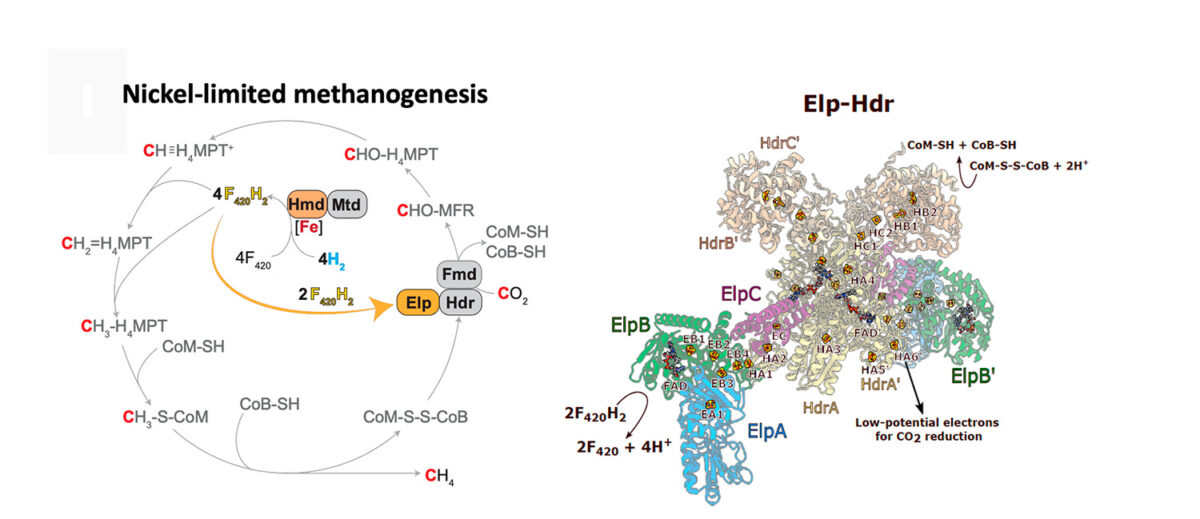
En este estudio mostramos que, cuando las arqueas metanógenas se encuentran en ambientes con muy poco níquel —una situación común en la naturaleza— reconfiguran por completo su vía metabólica para producir metano. En lugar de utilizar las hidrogenasas clásicas dependientes de níquel, activan una ruta alternativa basada en la hidrogenasa sin níquel Hmd y en un complejo que identificamos y caracterizamos, al que llamamos Elp–Hdr. Este complejo sustituye funcionalmente a las hidrogenasas habituales y permite mantener el flujo de electrones necesario para reducir CO₂. Mediante análisis proteómico y criomicroscopía observamos cómo se organiza y actúa este sistema alternativo, demostrando que es un mecanismo de adaptación conservado en muchos metanógenos. En conjunto, revelamos que estos microorganismos pueden redirigir su metabolismo central para sobrevivir cuando el níquel escasea.
Resumen
Methanogenic archaea are the main producers of the potent greenhouse gas methane1,2. In the methanogenic pathway from CO2 and H2 studied under laboratory conditions, low-potential electrons for CO2 reduction are generated by a flavin-based electron-bifurcation reaction catalysed by heterodisulfide reductase (Hdr) complexed with the associated [NiFe]-hydrogenase (Mvh)3,4,5. F420-reducing [NiFe]-hydrogenase (Frh) provides electrons to the methanogenic pathway through the electron carrier F420 (ref. 6). Here we report that under strictly nickel-limited conditions, in which the nickel concentration is similar to those often observed in natural habitats7,8,9,10,11, the production of both [NiFe]-hydrogenases in Methanothermobacter marburgensis is strongly downregulated. The Frh reaction is substituted by a coupled reaction with [Fe]-hydrogenase (Hmd), and the role of Mvh is taken over by F420-dependent electron-donating proteins (Elp). Thus, Hmd provides all electrons for the reducing metabolism under these nickel-limited conditions. Biochemical and structural characterization of Elp–Hdr complexes confirms the electronic interaction between Elp and Hdr. The conservation of the genes encoding Elp and Hmd in CO2-reducing hydrogenotrophic methanogens suggests that the Hmd system is an alternative pathway for electron flow in CO2-reducing hydrogenotrophic methanogens under nickel-limited conditions.

diciembre 2025
Sobre el grupo investigador
El trabajo ha sido dirigido por la doctora Bonnie J. Murphy, investigadora principal del grupo de metaloproteínas y proteinas redox del Instituto Max Planck de Biofísica (MPI Biophysics, Frankfurt, Alemania), y el profesor Seigo Shima del Intituto Max Planck de Microbiología terrestre (MPI terrestrial microbiology). El estudio se ha llevado a cabo gracias también a la estrecha colaboración con la unidad de microscopía electrónica del MPI Biophysics, dirigida por la doctora Sonja Welsch.
Referencia del artículo
Pablo San Segundo-Acosta, Shunsuke Nomura, Evgenii Protasov, Masanori Kaneko, Jörg Kahnt, Bonnie J Murphy, Seigo Shima. Electron flow in hydrogenotrophic methanogens under nickel limitation. Nature644, 490–496. 2025
https://doi.org/10.1038/s41586-025-09229-y