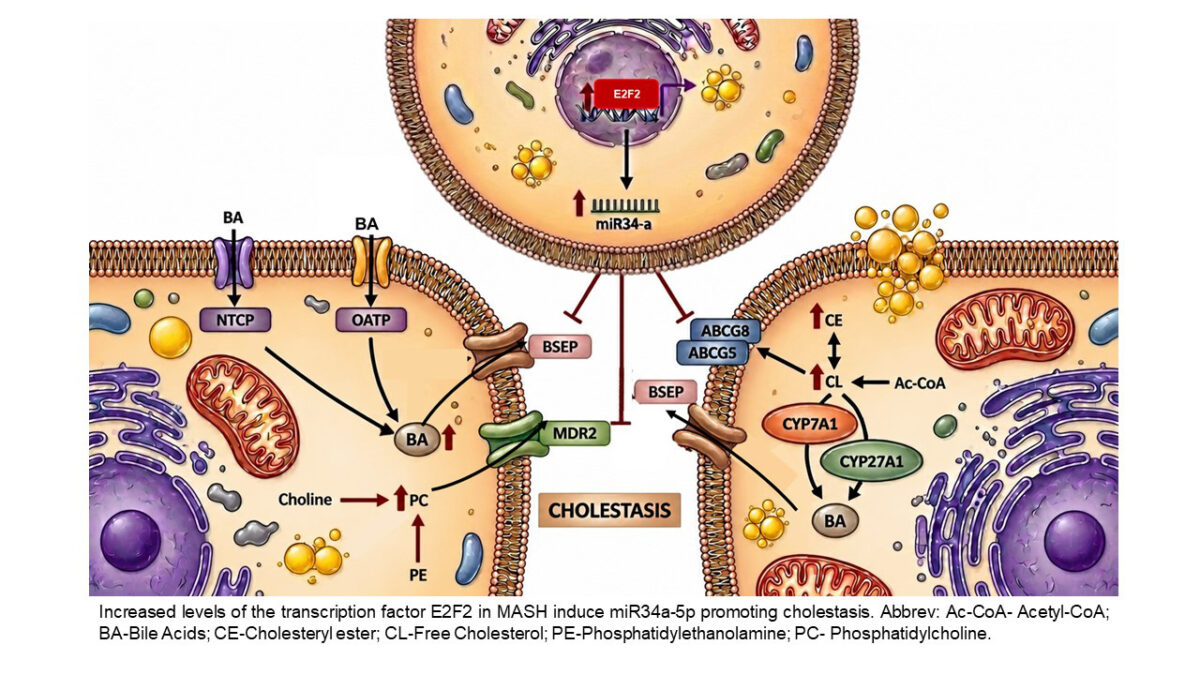
La esteatosis hepática metabólica (MASLD) es una patología progresiva y heterogénea que engloba distintos subgrupos de pacientes, entre ellos aquellos con un perfil colestásico presentan peor pronóstico. En este estudio investigamos el papel del factor de transcripción E2F2 en la progresión de MASLD hacia esteatohepatitis metabólica (MASH). Nuestros resultados revelan que E2F2 actúa como un regulador central del metabolismo hepatobiliar a través del microARN miR‑34a‑5p. Su sobreexpresión impulsa la acumulación de colesterol y ácidos biliares y compromete su excreción. Este eje molecular favorece la progresión hacia MASH con un componente colestásico.
Resumen
Background and Aims: Metabolic dysfunction–associated steatotic liver disease (MASLD) affects a heterogeneous group of patients. Among them, those with a cholestatic profile show worse outcomes. Here, we investigated whether E2F2 is involved in MASLD-associated cholestasis and, if so, the role of miRNAs.
Approach and Results: E2f2-knockout (E2f2−/−) and wild-type (WT) mice were fed a choline-deficient high-fat diet (ChD-HFD) or an HFD after injection of diethylnitrosamine (DEN-HFD) to induce metabolic dysfunction–associated steatohepatitis (MASH). E2F2 was overexpressed in the liver by AAV8. Cholestasis was induced by bile duct ligation or by a 3,5-diethoxycarbonyl-1,4-dihydrocollidine-enriched diet. microRNA sequencing was performed. Two biopsy-proven MASLD patient cohorts were used. E2F2 deficiency resulted in increased synthesis and excretion of cholesterol, phosphatidylcholine, and bile acids, reducing their storage in the liver while increasing their presence in feces. This was consistent with increased expression of genes involved in biliary lipid metabolism, reduced inflammation and fibrosis, and the generation of a distinct miRNA profile, thereby preventing MASH. Liver-specific induction of E2F2 in vivo hampered the transcriptional program involved in biliary lipid metabolism and upregulated miR-34a-5p, which was downregulated in E2f2−/− mice. The protective effects observed in E2f2−/− mice were lost when a miR-34a-5p mimic was used. Hepatic miR-34a-5p levels were elevated in patients with advanced fibrosis, inflammation, steatosis score, cholelithiasis, and increased serum bile acids and biliary lipids. E2f2 deficiency conferred protection against cholestatic liver injury.
Conclusions: E2F2 deficiency protects against MASH and cholestasis, preventing cholesterol accumulation, fibrosis, and inflammation through modulation of miR-34a-5p. This could provide therapeutic benefits for patients with cholestatic MASH.
Approach and Results: E2f2-knockout (E2f2−/−) and wild-type (WT) mice were fed a choline-deficient high-fat diet (ChD-HFD) or an HFD after injection of diethylnitrosamine (DEN-HFD) to induce metabolic dysfunction–associated steatohepatitis (MASH). E2F2 was overexpressed in the liver by AAV8. Cholestasis was induced by bile duct ligation or by a 3,5-diethoxycarbonyl-1,4-dihydrocollidine-enriched diet. microRNA sequencing was performed. Two biopsy-proven MASLD patient cohorts were used. E2F2 deficiency resulted in increased synthesis and excretion of cholesterol, phosphatidylcholine, and bile acids, reducing their storage in the liver while increasing their presence in feces. This was consistent with increased expression of genes involved in biliary lipid metabolism, reduced inflammation and fibrosis, and the generation of a distinct miRNA profile, thereby preventing MASH. Liver-specific induction of E2F2 in vivo hampered the transcriptional program involved in biliary lipid metabolism and upregulated miR-34a-5p, which was downregulated in E2f2−/− mice. The protective effects observed in E2f2−/− mice were lost when a miR-34a-5p mimic was used. Hepatic miR-34a-5p levels were elevated in patients with advanced fibrosis, inflammation, steatosis score, cholelithiasis, and increased serum bile acids and biliary lipids. E2f2 deficiency conferred protection against cholestatic liver injury.
Conclusions: E2F2 deficiency protects against MASH and cholestasis, preventing cholesterol accumulation, fibrosis, and inflammation through modulation of miR-34a-5p. This could provide therapeutic benefits for patients with cholestatic MASH.

junio 2026
Sobre el grupo investigador
El grupo Lipids&Liver liderado por la Dra. Patricia Aspichueta en la Universidad del País Vasco (EHU), se centra en el estudio de la fisiopatología del metabolismo de lípidos y lipoproteínas su relación con el desarrollo y progresión de la enfermedad hepática. Su investigación aborda patologías clave como la esteatosis hepática metabólica (MASLD) y el cáncer hepático primario (carcinoma hepatocelular y colangiocarcinoma) así como las metástasis hepáticas de cancer colorrectal. A través de aproximaciones integradas que combinan proteómica, lipidómica y biología molecular, el grupo identifica nuevas alteraciones metabólicas implicadas en la progresión de la enfermedad y busca marcadores de pronóstico y nuevas dianas terapéuticas, con un enfoque traslacional hacia la clínica.
Referencia del artículo
Apodaka-Biguri M., Simão A. L., González-Romero F., Mestre D., Rodrigues P. M., Aurrekoetxea I., Gómez-Santos B., Buqué X., Nieva-Zuluaga A., De Gauna M. R., Fernandez-Puertas I., Gomez-Jauregui P., Sainz-Ramirez N., Alfaro-Jiménez K., Ortiz-Palma A., Castillero E., Iglesias-Ara A., Mitxelena J., Eriz A., … Castro R. E., Aspichueta P. E2F2 transcription factor promotes a cholestatic MASH phenotype by regulating hepatobiliary metabolism through miR-34a-5p. Hepatology. 2025
https://doi.org/10.1097/HEP.0000000000001461